2026 Best Hydraulic Actuator Options for Global Buyers?
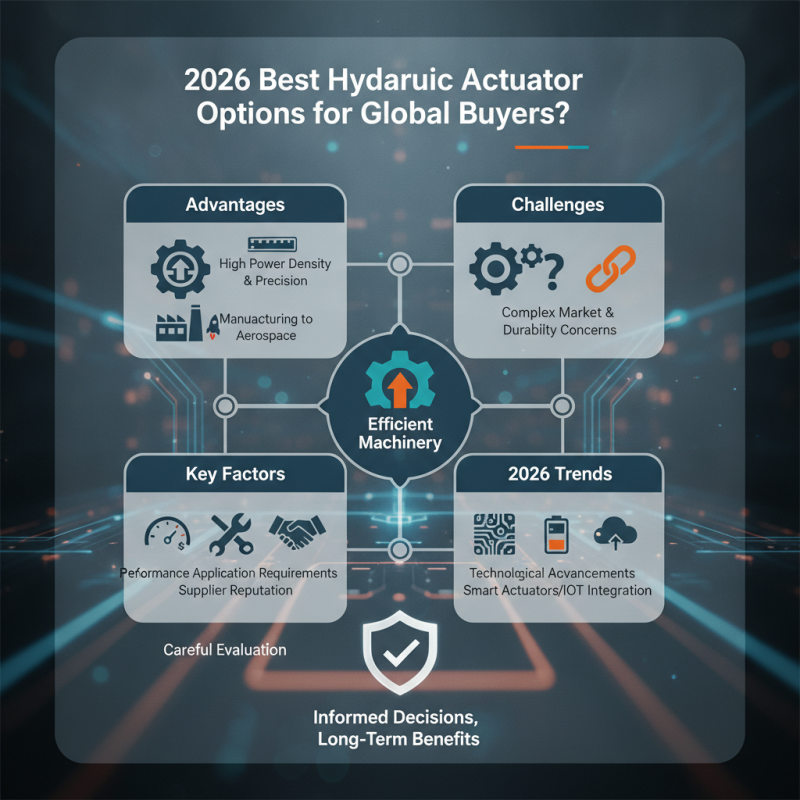
In today's industrial landscape, the need for efficient machinery has never been greater. Hydraulic Actuators play a crucial role in various applications, providing reliable movement and control. As global buyers seek the best options for 2026, understanding the emerging trends in hydraulic actuator technology is essential.
Hydraulic actuators offer distinct advantages, such as high power density and precision. Industries from manufacturing to aerospace rely heavily on these devices. However, not all hydraulic actuators are created equal. Buyers must navigate a complex market filled with varying specifications, pricing, and technological advancements. Some products may lack the durability expected, leading to costly downtime.
Moreover, selecting the right hydraulic actuator can be challenging. Buyers should consider factors like performance, application requirements, and supplier reputation. Users have shared experiences of encountering unexpected issues with lesser-known brands. A careful evaluation of options is vital, ensuring that investments lead to long-term benefits. In this context, a thorough understanding of the best hydraulic actuator options for 2026 will empower buyers to make informed decisions.
The Evolution of Hydraulic Actuators: Trends and Developments by 2026
The hydraulic actuator industry is undergoing significant changes as we approach 2026. Manufacturers are focusing on innovations that enhance performance and efficiency. New materials are playing a vital role. These materials contribute to increased durability and lighter weights. Improved designs are also appearing, making actuators more compact without compromising power.
As the demand for automation grows, hydraulic actuators are becoming more versatile. Applications in various sectors, from automotive to aerospace, are expanding. However, challenges remain. The need for energy efficiency pushes developers to seek alternatives that reduce energy consumption. This evolution often leads to increased complexity in design.
Trends indicate a shift towards smarter systems. Integration with IoT is becoming essential. Real-time monitoring can help users optimize performance but may introduce new vulnerabilities. Stakeholders must address these concerns while embracing technological advancements. The path to 2026 holds promising yet challenging prospects for hydraulic actuator buyers.
Key Specifications and Performance Metrics for Hydraulic Actuators
When choosing hydraulic actuators, understanding key specifications is crucial. Power output is one significant metric. Hydraulic actuators typically range from 1 to 20 kW in power output. The right power level can impact efficiency and operational performance. A carefully selected actuator can enhance the overall system responsiveness and precision.
Another vital specification is the stroke length and speed. Common stroke lengths lie between 25 mm and 1000 mm. Speed often varies between 5 mm/s to 50 mm/s across different applications. Selecting the optimal stroke and speed can lead to improved productivity in industrial settings. Ignoring these factors may lead to subpar performance.
Moreover, durability and maintenance requirements should be assessed. Many actuators boast a lifespan exceeding 10 years with proper maintenance. However, lower-quality options might require frequent replacements. Regular maintenance is essential to ensure optimal performance and prevent unexpected failures. Buyers must consider how these elements affect total cost of ownership.
Comparative Analysis of Major Hydraulic Actuator Types in 2026
In 2026, the landscape of hydraulic actuators is diverse. Buyers face several choices that cater to various industrial needs. Among the prominent types are linear and rotary actuators. Each type has unique features that determine its suitability for specific applications.
Linear hydraulic actuators are popular for their efficiency. They convert hydraulic energy into linear motion. These actuators excel in tasks like pushing, lifting, and moving heavy loads. However, their design can limit speed in some scenarios. It's essential to reflect on the operational requirements to avoid mismatches in application.
Rotary hydraulic actuators, on the other hand, provide motion in a circular direction. They are ideal for applications requiring rotation. While they have a high torque output, they may pose challenges in precision applications. Understanding the environment and load requirements can prevent inefficiencies. Making informed choices ensures that hydraulic systems operate optimally, maximizing productivity.
Market Demand and Leading Manufacturers of Hydraulic Actuators Globally
The global market for hydraulic actuators is witnessing significant growth. Industries such as automotive, aerospace, and manufacturing are driving this demand. Advanced technology and automation move production lines. This trend emphasizes the need for efficient actuation solutions. However, the dependency on suppliers from different regions raises concerns about stability and supply chain disruptions.
Leading manufacturers are innovating to meet rising demands. They focus on creating actuators that promise durability and higher performance. Users expect reliability in various environments, especially in harsh conditions. Yet, variations in materials and techniques raise questions about quality standards. The complexity of designs can lead to potential failures if not adequately tested.
Hydraulic actuators require ongoing evaluation. As industries change, so do their needs. Keeping pace with technological advancements is vital. Failure to adapt could leave certain players behind. Manufacturers must engage in continuous research. This ensures they provide solutions that meet evolving expectations. There's always room for improvement in efficiency and sustainability.
Sustainability and Technological Innovations in Hydraulic Actuator Solutions
Hydraulic actuators are essential in many industries. They convert hydraulic energy into mechanical motion. As sustainability becomes more critical, manufacturers focus on environmentally friendly designs. Innovations in materials are leading the way. Lightweight composites reduce energy consumption, while recyclable materials help decrease waste.
Technology also plays a significant role in improving efficiency. Smart sensors monitor actuator performance in real-time. This data allows for predictive maintenance, reducing downtime and repair costs. Integrating IoT technology can enhance connectivity between hydraulic systems and control centers. This connectivity leads to better decision-making.
Tips: Consider the environmental impact of materials when choosing an actuator. Look for options that offer durability without compromising sustainability. Regularly assess your hydraulic systems for maintenance needs, ensuring long-term functionality and efficiency. Embrace new technologies as they can provide insights into performance. They can help optimize your operational strategies.