
How to Choose an Automotive Door Lock Switch in 2026?
Choosing an automotive door lock switch in 2026 requires more than matching a connector. The switch controls daily security, cabin access, and driver convenience. A poor choice may create intermittent locking, weak button feedback, or unnecessary diagnostic work.
James D. Halderman, a respected automotive service educator, often reminds technicians, “A good diagnosis always begins with the basics.” That advice applies here. Confirm the vehicle’s year, trim, door position, connector shape, and communication system. Some newer vehicles use body-control modules and LIN communication. A simple-looking switch may therefore need precise electronic compatibility.
Look closely at the physical details. The button should return cleanly, without sticking or rattling. Examine the housing around the terminals. It should feel solid, not brittle. Sealed contacts matter in doors, where moisture, dust, and temperature changes are common. Compare the original switch beside the replacement before installation. Small differences can affect panel fit.
Material quality matters.
Check the supplier’s testing information, warranty, traceability, and return policy. Independent testing is more convincing than broad claims such as “premium quality.” A switch that fits today may still fail early if its contacts are poorly protected. That possibility deserves attention.
No buying guide is perfect. Vehicle variations can surprise even experienced technicians. Still, careful identification and practical inspection greatly reduce risk. The right automotive door lock switch should provide dependable operation, clear tactile feedback, and stable performance throughout years of everyday use.
Understanding Automotive Door Lock Switch Types and Functions
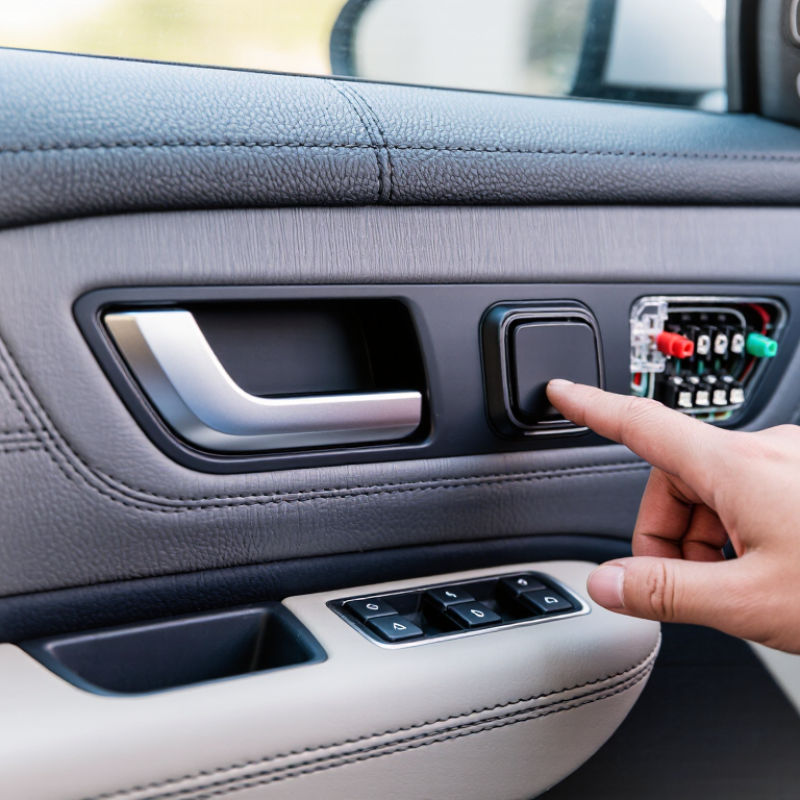
Choosing an automotive door lock switch starts with understanding its type and function. A basic power switch sends a lock or unlock command through a relay. Newer electronic switches communicate with a body control module over the vehicle network. Some vehicles also use capacitive touch surfaces or switches integrated into the door handle. The appearance can mislead.
In practical inspection, check the switch position, tactile resistance, backlighting, and connector condition. The button should return cleanly, without sticking or excessive movement. A central-locking switch may control all doors, while a selective-unlock switch opens only the driver’s door first. Rear-door lockout functions add another layer of protection. According to NHTSA’s Federal Motor Vehicle Safety Standard 206, door locks and retention systems must meet specific performance requirements, although the standard does not evaluate switch comfort. That difference matters.
Market reports from MarketsandMarkets identify electronic growth as a major direction in automotive switching systems, supported by connected vehicle electronics. However, more electronics can mean more diagnostic steps. A failed switch may resemble a wiring, actuator, fuse, or software fault. NHTSA reported 40,901 U.S. traffic fatalities in 2023, reminding engineers that small controls sit within larger safety systems. I would not choose by button feel alone. Test the circuit. Check the service data. A perfect choice is unlikely. Reliability, compatibility, sealing, and clear feedback deserve equal attention.
How to Choose an Automotive Door Lock Switch in 2026? - Understanding Automotive Door Lock Switch Types and Functions
| Switch Type or Arrangement | Primary Function | Typical Electrical Configuration | Common Vehicle Application | Main Advantages | Important Limitations | Selection Checks |
|---|---|---|---|---|---|---|
| Momentary Rocker or Push Switch | Sends a temporary lock or unlock command while the control is pressed. | Usually a momentary contact device; the vehicle control module or relay determines the lock duration. | Interior door panels, center consoles, and auxiliary access-control panels. | Simple operation, compact construction, and easy integration with low-current control circuits. | It normally does not provide automatic timing, remote operation, or security authorization by itself. | Confirm momentary action, terminal count, mounting dimensions, connector style, and circuit voltage. |
| Master Door Lock Switch | Controls the central locking system for several doors from the driver or front passenger position. | Often provides separate lock and unlock signal paths to a body control module, relay module, or central locking controller. | Passenger cars, sport utility vehicles, vans, and light commercial vehicles with power door locks. | Convenient centralized control and compatibility with electronic locking logic. | A failed switch may affect multiple doors; the switch is not necessarily capable of driving lock actuators directly. | Match the vehicle’s lock logic, number of terminals, illumination circuit, connector, and switch-panel shape. |
| Individual Door Lock Switch | Controls the lock or unlock function for one door or provides a local command to the vehicle network. | May be a simple two-position control or a low-current signal input monitored by the body control module. | Rear passenger doors, sliding doors, liftgate areas, and vehicles with separate local controls. | Allows localized control and can simplify door-specific user interfaces. | It may not operate other doors unless the vehicle control system is programmed to do so. | Check whether the switch is door-specific and verify left/right position, connector orientation, and wiring pinout. |
| Polarity-Reversing Lock Control | Drives a reversible door-lock actuator by changing the polarity applied to the actuator motor. | Commonly uses relay contacts or an electronic driver to provide opposite polarity for lock and unlock movement. | Older or simpler power-lock systems that use direct motor-control circuits. | Can control a two-wire reversible motor with distinct lock and unlock directions. | Incorrect wiring can cause short circuits, actuator damage, or simultaneous opposing commands. | Verify wiring diagrams, fuse protection, relay capacity, actuator current, and whether the vehicle uses a direct or module-controlled circuit. |
| Body-Control-Module Signal Switch | Provides a low-current input that a body control module interprets as a lock or unlock request. | Typically uses low-current contacts or a resistor-coded input; the module controls relays, actuators, timing, and safety logic. | Modern vehicles with centralized electronic body systems and networked door functions. | Supports timed operation, selective unlocking, security logic, and integration with vehicle status signals. | Electrical compatibility depends on the vehicle module; applying actuator power directly to the signal circuit can cause damage. | Identify the input type, reference voltage, ground strategy, connector pinout, diagnostic requirements, and module compatibility. |
| Illuminated Door Lock Switch | Combines lock/unlock control with backlighting for nighttime visibility. | Contains switching contacts plus a separate LED or bulb circuit; illumination may use a dedicated ground and lighting feed. | Interior door trim, center consoles, and vehicles with instrument-panel dimming systems. | Improves usability in low-light conditions and can match the vehicle’s interior lighting system. | Incorrect polarity or incompatible dimming voltage can prevent illumination or shorten light-source life. | Check light-source type, polarity, current draw, illumination voltage, connector terminals, and dimming compatibility. |
| Door Lock/Unlock and Child-Lock Combination Control | Controls power locking while providing a separate command or indicator for child-safety locking functions. | May contain independent momentary contacts, a maintained switch, or module inputs for the child-lock actuator. | Rear-door systems where child-safety locking is electronically controlled. | Combines related rear-door functions in one user interface. | Child-safety locking is a separate safety function and must not be assumed to operate from the normal lock contact. | Confirm the number of independent circuits, switch positions, safety interlocks, warning indicators, and vehicle software support. |
| Commercial-Vehicle Heavy-Duty Switch | Provides repeated lock or unlock commands in vehicles exposed to frequent use, vibration, or harsher environments. | May use reinforced contacts, sealed construction, and a higher electrical rating than a standard interior switch. | Vans, buses, work trucks, service vehicles, and fleet-operated vehicles. | Better resistance to frequent operation, vibration, dust, and moisture when properly sealed. | Larger dimensions, higher cost, and different connectors can reduce interchangeability with passenger-car parts. | Check operating cycles, ingress protection, vibration resistance, contact rating, mounting strength, and environmental temperature range. |
| Low-Voltage Passenger-Vehicle System | Operates within the vehicle’s low-voltage electrical architecture and supplies either a control signal or actuator power. | Most passenger vehicles use a nominal 12 V electrical system; charging voltage is higher while the engine is running. | Passenger cars and light vehicles with conventional low-voltage power-lock systems. | Widely supported by automotive switches, relays, body modules, and actuators. | A “12 V” label alone does not confirm terminal layout, current capacity, or signal compatibility. | Verify actual operating range, load current, transient protection, fuse rating, and whether the circuit is signal-level or power-level. |
| Higher-Voltage Commercial-Vehicle System | Provides lock-control commands in selected heavy-duty vehicle electrical systems. | Some heavy-duty vehicles use nominal 24 V electrical systems; the switch must be rated for the system voltage. | Selected buses, trucks, and specialized commercial vehicles. | Suitable for vehicle platforms designed around higher system voltage. | A switch intended only for a 12 V circuit may have unsuitable illumination, insulation, or contact specifications. | Confirm nominal and maximum voltage, contact rating, illumination rating, wiring standard, and vehicle-specific pinout. |
Note: Automotive door-lock switch specifications vary by vehicle architecture. Always verify the wiring diagram, connector pinout, actuator current, control-module requirements, mounting dimensions, and safety functions before installation.