
How to Choose a Fabric Testing Machine in 2026?
Choosing a fabric testing machine in 2026 requires more than comparing prices, brands, or touchscreen features. Textile production is becoming larger and more complex. Textile Exchange reported that global fiber production reached approximately 124 million tonnes in 2023 and may approach 160 million tonnes by 2030. More materials mean more testing variables.
A reliable fabric testing machine should match the fabric’s end use, construction, and applicable standard. A denim laboratory may prioritise tensile strength, tear resistance, and abrasion testing. A sportswear manufacturer may need stretch recovery, pilling, bursting, and moisture-related evaluations. ISO 139 also highlights the importance of controlled conditioning, including 20°C temperature and 65% relative humidity. Small environmental changes can alter results.
Textile testing specialist Dr. Subhash K. Batra has stated, “A test is only as good as the method behind it.” That principle deserves attention. A powerful machine cannot correct poor sampling, unsuitable clamps, or careless calibration. ASTM D5034, ASTM D1424, ASTM D4966, and relevant ISO methods should guide the purchase. Reports from Grand View Research and Smithers also point toward stronger demand for automated and repeatable textile quality control, although market forecasts differ. I would not treat every forecast as fact.
The best decision balances accuracy, maintenance, operator skill, software traceability, and future testing needs. Look closely at the grips. Check the calibration records. Ask whether local technicians can service the machine. Sometimes, the cheapest option becomes expensive. And sometimes, the most advanced system is simply unnecessary.
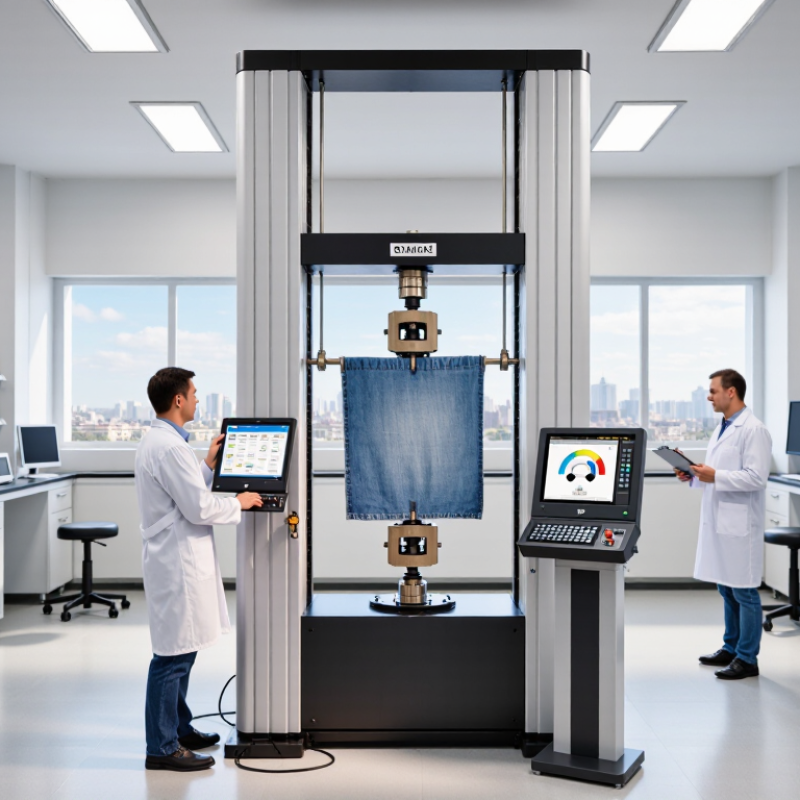
Define the Testing Goals and Fabric Performance Requirements
Choosing a fabric testing machine in 2026 should begin with a clear testing goal. A laboratory may need tensile strength, tear resistance, bursting pressure, abrasion, or colorfastness data. Each test exposes a different failure risk. Do not start with machine features. Start with the fabric’s intended use. Lightweight shirt fabric needs different evidence than upholstery or protective workwear.
I recommend listing expected stress, movement, moisture, temperature, and washing conditions before comparing equipment. For example, stretch fabric may require repeated extension cycles, not one simple pull. Record target loads, extension rates, specimen sizes, conditioning time, and acceptable variation. These details help technicians select suitable grips, sensors, chambers, and software. They also improve repeatability between operators and laboratories. Small omissions matter. A machine can be accurate yet unsuitable for the question being asked.
Reliable decisions should follow recognized textile test methods and documented calibration practices. Review required standards, measurement range, resolution, data storage, and maintenance needs with qualified technicians. In practice, I would test representative samples first, including seams, coatings, and dyed areas when relevant. One weakness remains easy to overlook: production fabrics rarely behave perfectly. Early trials may reveal uneven edges or inconsistent conditioning. That is useful evidence, not a nuisance. If results conflict, investigate specimen preparation before blaming the machine. Choose equipment that answers today’s question and adapts to future material changes.
How to Choose a Fabric Testing Machine in 2026? — Define the Testing Goals and Fabric Performance Requirements
| Testing Goal | Fabric Performance Requirement | Recommended Machine Type | Key Machine Specifications | Common Test Method | Typical Test Output | Selection Priority |
|---|---|---|---|---|---|---|
| Tensile strength and elongation | Confirm that woven or knitted fabric withstands production, wear, and end-use loads. | Electronic universal tensile testing machine with interchangeable grips. | Load-cell capacity selected for the material; constant-rate-of-extension control; suitable gauge length; jaw faces that prevent slippage. | ISO 13934-1 or ASTM D5034 | Maximum force, breaking elongation, force–elongation curve, and results in warp/weft or wale/course directions. | Very high |
| Tear resistance | Evaluate resistance to propagation of a cut or tear during handling and service. | Pendulum tear tester or tensile tear testing system, depending on the selected method. | Appropriate pendulum range or low-force load cell; calibrated cutting template; stable specimen clamping. | ISO 13937-1 or ASTM D1424 | Tear force, usually reported separately for machine and cross-machine directions. | High |
| Abrasion resistance | Measure resistance to surface wear caused by repeated rubbing. | Rotary platform or linear abrasion tester with controlled pressure. | Adjustable load, defined rubbing motion, programmable cycle counter, and specimen-holding system for fabric thickness. | ISO 12947-1 to ISO 12947-4 or ASTM D4966 | Cycles to specified damage, mass loss, appearance change, or breakthrough. | Very high |
| Pilling and fuzzing | Assess formation and severity of pills caused by wear and laundering. | Random tumble pilling tester or controlled rubbing pilling tester. | Consistent chamber motion, controlled test duration, lint collection, and standardized visual assessment lighting. | ISO 12945-1, ISO 12945-2, or ASTM D3512 | Pilling grade, fuzzing grade, and visual rating after a defined number of cycles. | High |
| Dimensional stability | Control shrinkage, growth, and skew after washing or relaxation. | Fabric dimensional-change measurement system combined with a controlled washing and drying procedure. | Accurate reference marking, calibrated scale or image measurement, controlled wash temperature, agitation, and drying conditions. | ISO 5077 or AATCC TM135 | Percentage change in length and width, plus appearance or skew observations. | Very high |
| Colorfastness to washing and rubbing | Verify resistance to color change and color transfer during laundering or contact. | Colorfastness washing apparatus, crockmeter, and standardized gray-scale or instrumental evaluation system. | Controlled liquor ratio, temperature, agitation, rubbing pressure, and repeatable illumination or spectrophotometric measurement. | ISO 105-C06 and ISO 105-X12 | Color-change grade, staining grade, or color difference value. | High |
| Air permeability | Evaluate breathability for apparel, sportswear, uniforms, and technical textiles. | Digital air-permeability tester with interchangeable test heads. | Stable pressure differential, appropriate test area, automatic flow measurement, and correction for fabric thickness or leakage. | ISO 9237 or ASTM D737 | Air-flow rate or air permeability at a specified pressure differential. | Medium to high |
| Water resistance and repellency | Distinguish surface water repellency from resistance to hydrostatic pressure or leakage. | Spray-rating tester, hydrostatic-pressure tester, or rain-tower system according to the product claim. | Controlled water delivery, pressure ramp, specimen sealing, leak detection, and suitable test head for coated or laminated fabrics. | ISO 4920, ISO 811, or AATCC TM22 | Spray rating, hydrostatic pressure, penetration time, or leakage classification. | High for outdoor and protective fabrics |
| Fabric handle and bending behavior | Quantify stiffness, drape, flexibility, and handle-related differences between fabric constructions. | Bending-length tester or automated drape tester. | Low-friction support surface, controlled specimen dimensions, image-based drape measurement, and repeatable conditioning. | ISO 9073-7 or ASTM D1388 | Bending length, flexural rigidity, drape coefficient, or drape profile. | Medium |
Selection note: Test speeds, specimen dimensions, conditioning atmosphere, pressure levels, cycle counts, and acceptance criteria must be set according to the applicable standard, product specification, and intended end use. Typical laboratory conditioning for many textile tests is 20 ± 2 °C and 65 ± 4% relative humidity, unless the selected method specifies otherwise.
Related Posts
-
Top 10 Textile Inspection Machine Benefits for Global Buyers?
-

2025 Top 10 Textile Printing Machines Revolutionizing the Industry
-
2026 Best Wet Spinning Machine for Global Buyers?
-

Top 10 Carding Machine Innovations You Should Know About?
-
Top Fabric Inspection Machine Solutions for Global Buyers?
-
Top 10 Textile Machinery Tips for Global Buyers to Consider